

Trailblazers take strategic risks to meet the moment, move forward
Barry Schieferstein, Thad Lurie, Stacie Manger, Korie Traver and Natasha Goodwin honored for innovative achievements.
- November 3, 2025 |
-
 CHRISTINA FOLZ
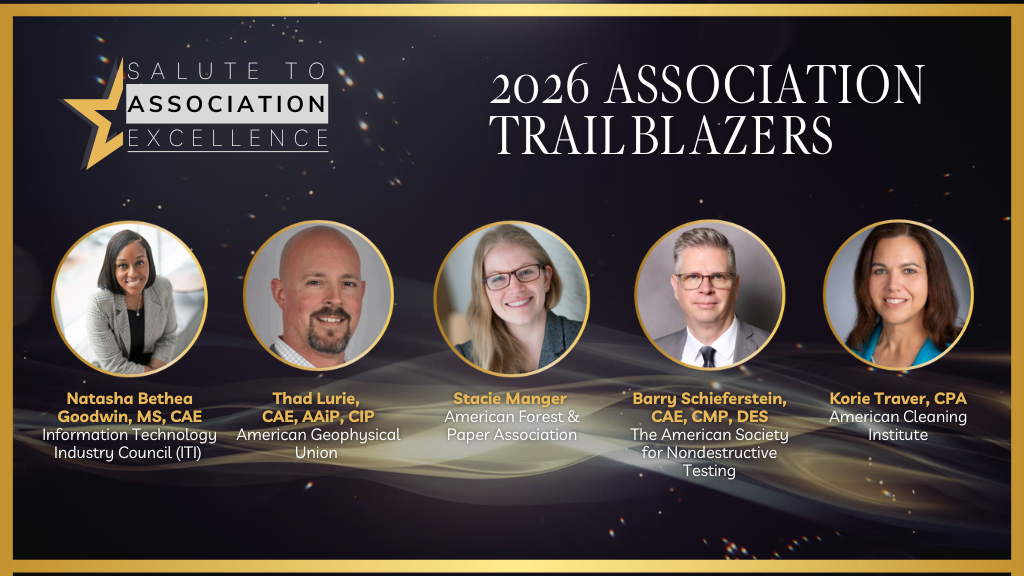
As this year’s Salute to Association Excellence Trailblazer Award recipients demonstrate, professional bravery is a necessary but not sufficient criterion for receiving the honor. In other words, it’s not just about being willing to take risks. It’s about taking the right risk at the right time.
Whether they’re reimagining traditional membership or leadership models, harnessing technology in powerful new ways, or doubling down on the enduring aspects of associations’ value in turbulent times, these pioneers combined wisdom, creativity and courage to drive their organizations forward.
From premium to 'freemium'
When Barry Schieferstein started working at the American Society for Nondestructive Testing (ASNT) seven years ago, he was new to the association world and thus had no preconceived notions about how things should be done. While some might consider that a liability, his fresh perspective has been vital to his success. ASNT, an 84-year-old organization based in Columbus, Ohio, represents professionals who use scientific techniques to detect flaws in materials and structures.
After serving as ASNT’s director of events for six years, Schieferstein became chief operating officer in July 2024.
Under his leadership, in January ASNT introduced a no-cost, or “freemium,” membership model that yielded 2,800 new members, 80% of whom had not engaged with ASNT in the past. “That group of people has generated about $120,000 in incremental revenue,” Schieferstein said.
Schieferstein noted that they launched the effort without the benefit of benchmarking. “We had no data sets to compare ourselves to, because nobody else is really in the association space that has done this to (this) extent,” he noted.
ASNT’s bold approach came from overturning one of the association world’s cherished assumptions: the outdated notion that membership is where all the money is. Today’s revenue picture is far more multifaceted. “We talk about nondues revenue like it’s a side hustle,” Schieferstein said. “It really isn’t.” He pointed out that a single event might generate 70% of revenue for trade organizations.
With member dues at ASNT accounting for a mere 8% of revenue, the organization decided that reinventing membership was a strategic risk worth taking. After opening its doors to anyone interested in joining, ASNT focused its growth efforts on a wealth of paid programs, events and resources. “I don’t care if somebody writes me a check for $100 for membership or buys a $100 book,” Schieferstein said. “It’s still revenue.”
The culture at ASNT is one where ingenuity like Schieferstein’s is routinely rewarded. Indeed, the organization’s board recently created an “innovation fund” that allows employees to take on creative initiatives that fall outside the normal budget.
“There isn’t an area that hasn’t transformed, or a department that we haven’t transformed, since our CEO has been here,” said Schieferstein of Neal Couture, ASNT’s CEO since 2019.
Even experiments that don’t work can be redirected into finding out what does. “It’s (about) learning to fail fast and fail correctly,” Schieferstein said. “We’ve got in place a leadership team that is very risk-tolerant.”
AI and true teamwork
Although the innovative technology Thad Lurie and team rolled out at the American Geophysical Union (AGU) integrates state-of-the-art artificial intelligence (AI), its true power comes from the people behind it. “I have not seen a case where AI can do something without human judgment around it,” said Lurie, the visionary leader behind the initiative, which brings personalized content to AGU members in much the same way Netflix cues up entertainment offerings based on the individual.
Lurie, senior vice president of digital and technology at AGU, a Washington-based global association representing professionals in Earth and space sciences, credits the success to staff and their impressive vendor.
Lurie’s team wanted to better connect each AGU member with the content most relevant to them among the organization’s vast resources. After interviewing three potential AI vendors, Lurie found that the fourth candidate, called Blue Cypress, addressed his desire to create novel connections.
“We used AI and natural language processing to leverage the published content and scientific abstracts that our community has given us to match them to other content, research, and people that are very much (aligned with) what they’re working on,” Lurie said. This approach enabled AGU to customize their member offerings in unprecedented ways.
“We’re seeing engagement rates anywhere from five to 10 times higher than normal,” Lurie said. For instance, in a recent test comparing performance of an email sent to a random sample of members with that of an email sent to members whose expertise matched up with the ask, the tailored email yielded a conversion rate more than four times higher than the general one (26% vs. 6%).
Lurie said his leadership style has evolved during his time at AGU. While he used to be highly product- and delivery-oriented, he’s become much more people-centric and trust-based — an approach that, ironically, was pivotal to this delivery-oriented outcome.
“I spent a lot of time setting up one-on-ones, having conversations with people, making sure that we had line of sight and clear communication into not only what we were trying to do, but how we were supporting (members and staff) and what they were trying to do,” he said. “That’s how the business works best — when we’re all working together.”
Stepping up by stepping aside
While C-suite executives are well practiced at stepping in to solve problems, Stacie Manger knows when to step aside — and listen to others — to unlock success. “Being able to remove ourselves from the equation is something our team is really good at,” said Manger, director of digital and UX strategy at the American Forest and Paper Association (AF&PA).
Beginning with a website redesign in 2021, Manger spearheaded a user-focused digital strategy called “Search First” that bolstered search engine optimization and elevated the visibility of AF&PA, a trade association based in Washington that represents the U.S. paper products industry.
In short, “We put ourselves in our audience’s shoes,” Manger explained. “What words are they using? What do they already know? What language resonates? And then we build our entire strategy around that,” she said.
The strategy is working: AF&PA’s content now appears in search engine results for roughly 1,500 keywords. “And we’ve done this all organically,” she added. “We’re not paying for anything we’ve done.”
A self-proclaimed data nerd, Manger describes her role as managing “everything that touches the internet,” including AF&PA’s website, content strategy, graphics and more. The UX, or user experience, part of her title means she’s keenly focused on ensuring that all that content is easy for people to find and navigate.
Often that involves convincing executives and experts alike to cede control on key messaging in the association. “It can be really hard for subject matter experts … to hear from someone on our team that we have to adjust that message so the audience will understand it,” Manger said.
Manger works closely with these stakeholders to determine the best way to make complex ideas accessible and accurate. “That means that I get on calls with them,” she said. “I screen-share while I’m typing, so they can see … how I’m changing it to make sure it’s technically right. And it means I send over drafts, and they will track-change and comment, and then I will sit with it and try again.”
While this process is time-consuming, she and her team have built so much trust that these experts now depend on them to develop effective language.
Manger leveraged that same diplomatic finesse to convince AF&PA’s senior leadership to let her take an analytics-based approach to streamlining email efficiency within the organization. “Courage to me means you’re raising the bar, even when nobody’s asking you to do it,” she said.
When are two CEOs better than one?
The role of interim CEO is not for the fainthearted. Those who take it on are often thrust into the position with little context and no guidance — which is why most boards don’t ask interims to do much beyond maintain status quo.
That wasn’t the case for Korie Traver, chief operating officer at the American Cleaning Institute (ACI), who not only had to share a nine-month CEO stint with a colleague, but was asked to rapidly expand the organization while she was doing it.
Coming off a pandemic that drove demand for cleanliness, ACI was in the midst of a major growth spurt when former CEO Melissa Hockstad announced she was stepping down in late 2024. Based in Washington, ACI represents producers of household, institutional and industrial cleaning products.
“(The board) said, if you leave the ship just afloat, you’re actually going backwards, so we … task you with continuing the forward growth,” Traver said.
Traver and co-CEO Doug Troutman, ACI’s senior vice president of government affairs at the time, were charged with increasing head count by 25% (from 28 to 35 staff) and overseeing ACI’s adoption of an agile workflow, which involves redesigning every work function for maximum flexibility.
The pair not only hired someone to lead the workflow project, but helped develop processes and get staff buy-in. They created and hired for a new executive role — vice president of sustainability — in addition to meeting other growth goals. “I’m really proud of the decisions Doug and I made during that period,” Traver said.
Traver describes her leadership style as people-focused: “You can’t be a successful leader of your people if you don’t show them that they can trust you.”
A key reason for the co-CEOs’ success is that they complemented each other well. During COVID, Hockstad developed a contingency plan naming them shared leaders in her absence. After being promoted from chief financial officer to COO in 2023, Traver brought an excellent grasp of business and operations to the interim CEO role, while Troutman drew on deep legal knowledge and advocacy prowess.
“We both put our egos aside and said, ‘Hey, we’re here for the organization.’”
As the duo delivered remarkable results, the board focused on filling the top position, bringing on current CEO Jennifer Abril in August. In September, Troutman took a position with the U.S. Environmental Protection Agency at the Trump administration’s request.
Meanwhile, Traver returned to her COO role as a stronger, more strategic leader.
Just be brilliant
When your members are the biggest technology companies in the world — ranging from Accenture to Zoom — who do you put in charge of membership? While some might gravitate toward a high-powered tech professional, those with a deeper understanding of associations know the answer is a high-powered connector.
“I’m a true association professional,” said Natasha Goodwin, vice president of membership at the Information Technology Industry Council (ITI), a Washington-based global trade association for the tech industry. In her six years at ITI, Goodwin quickly ascended from membership director to senior director to vice president. Before that, she leveraged her expertise cultivating robust member communities at the Association for Psychological Science and the American Nurses Association.
Goodwin is not one to dwell on her many accomplishments. “I’m better when folks are better around me,” she said. “I’ll be the first one to point out … this person was able to do this, and that’s why I can be successful.”
That focus on team is vital for the survival of today’s associations. “I think the biggest challenge — a lot of associations are going through this — is where the economy is right now, and getting our member companies to renew,” Goodwin said, adding that association memberships are often first to go when companies tighten their budgets.
Successful retention comes back to mastering the basics. “Before the pandemic, it was just so easy to keep our members,” Goodwin said. “Now it’s … tougher, but it’s a challenge that we’re up for.”
In addition to using effective segmentation strategies to ensure broad member engagement — from young professionals through the C-suite — she’s focused on cultivating valuable touchpoints for member-to-member connection. In the post-COVID world, Goodwin advises association leaders to “be very intentional about how you’re creating moments for your members to network.”
To ensure members remain front and center in everything ITI does, Goodwin’s work is embedded across functions. She collaborates with ITI’s AI working group to ensure customized member experiences, for example, and works with the vice president of communications to make ITI’s website more user-friendly and global.
Goodwin is also known among colleagues as the go-to source for work and career advice. “I’m a servant leader,” she said. “I think that’s why a lot of people come to me for mentorship.”
She hopes to inspire her two daughters as well. “I’m really trying to instill in my girls that the sky’s the limit, you can do anything,” she said. “They’re definitely my motivation to keep striving … and helping other young women around me get to whatever their goals are, and just be professionally brilliant.”